Morphologically and size-uniform particles
Monodisperse particles and shape-directed self-assembly developed with the University of Pennsylvania.
Try “fiber”, “inkjet”, “spirits”, “serial”, “LightMap”
Intelligent Material connects the physical world with the digital world. Our inert rare-earth crystals convert energy into measurable information. We engineer the crystal itself, changing how it interacts with light, energy, magnetic fields and its surrounding environment.
The most powerful use of Intelligent Material is becoming part of the product itself. Once the crystal is inside a polymer, coating, ink, oil, fiber, biological assay or other compatible system, the product carries a persistent engineered response from the moment it is made.
We can encode information into composition, structure, wavelength response, lifetime, excitation dependence, magnetic behavior and core/shell interactions.
The result is a material that can convert energy, carry information and remain physically connected to the thing being measured, authenticated or controlled.
Uniform by design
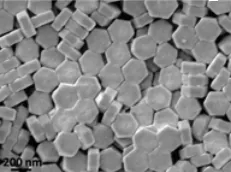
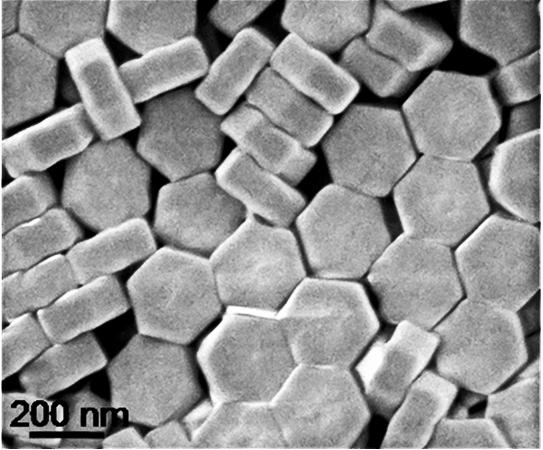
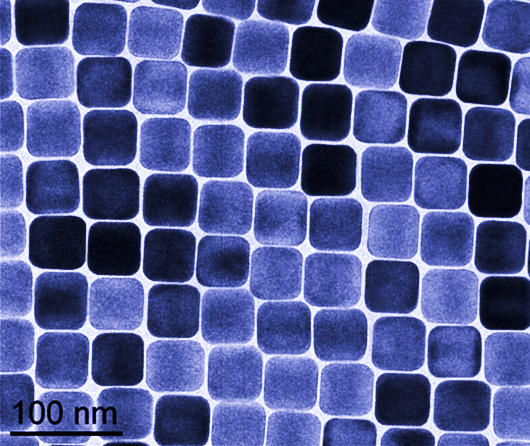
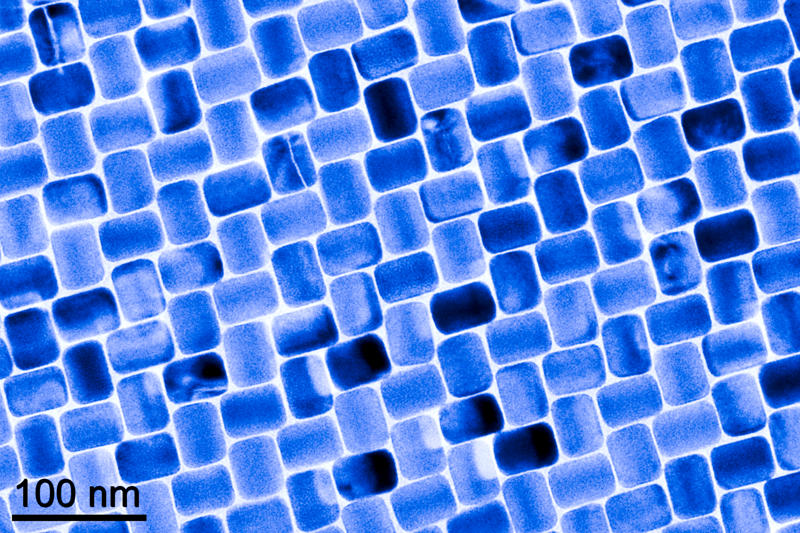
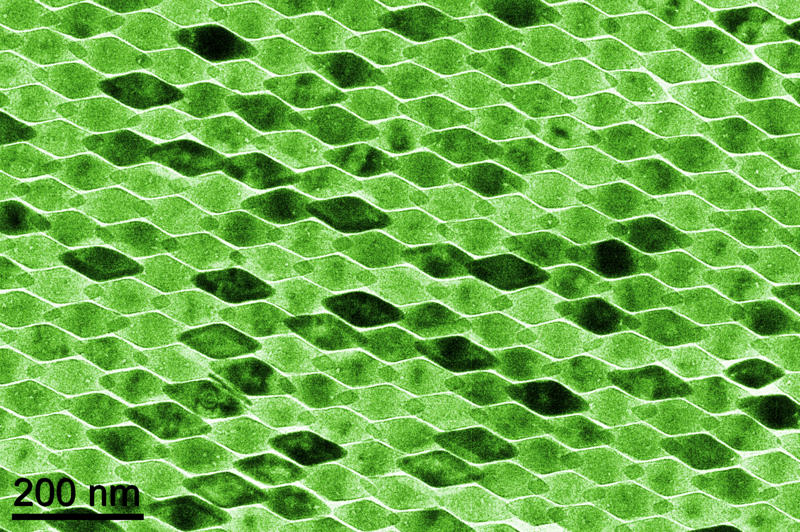
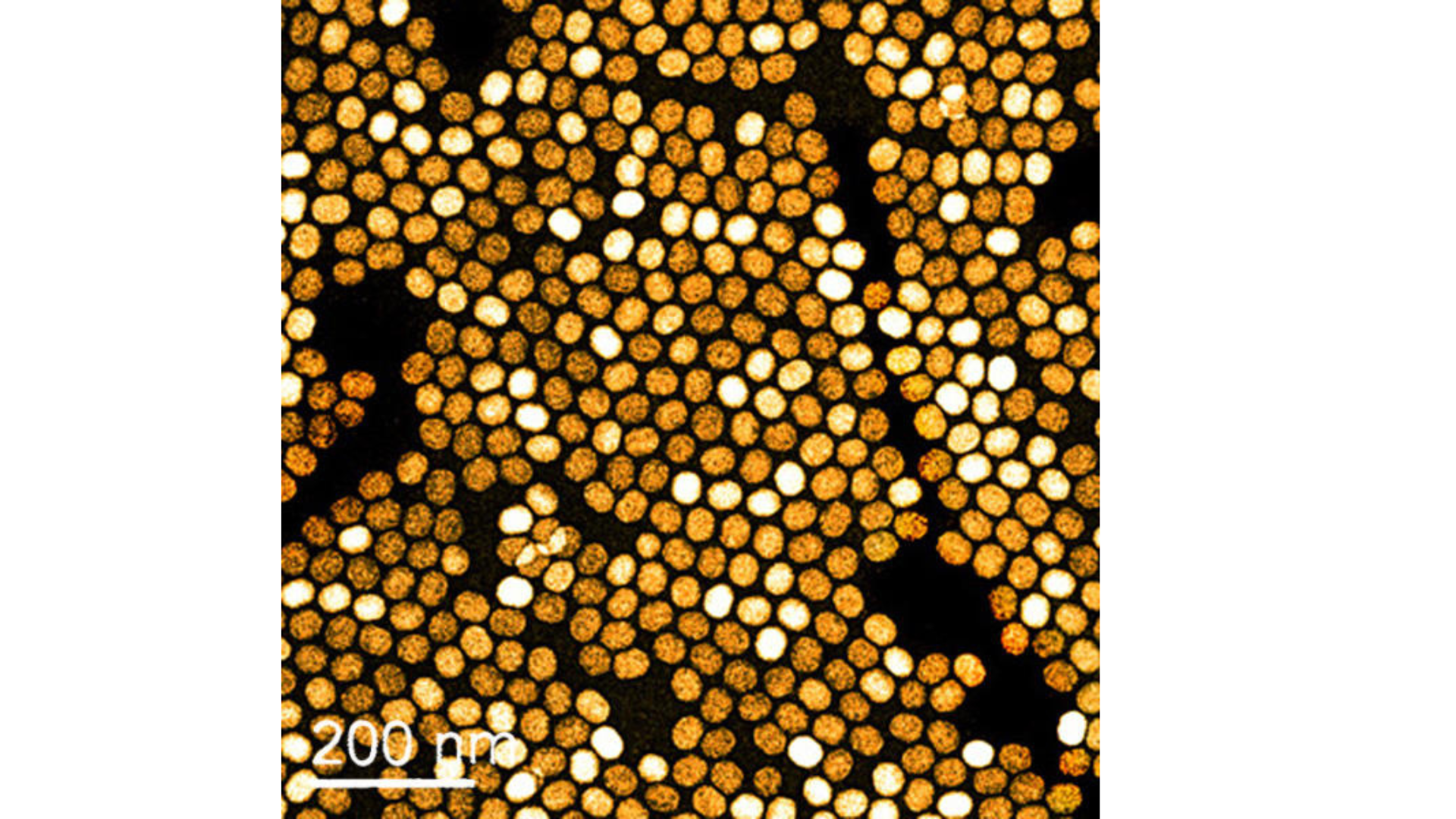
Intelligent Material® is grown to a recipe, not ground down from a rock. The crystals come out the same size and the same shape, batch after batch. Look closely: hundreds of them, and hardly one out of line.
Why our crystal is different
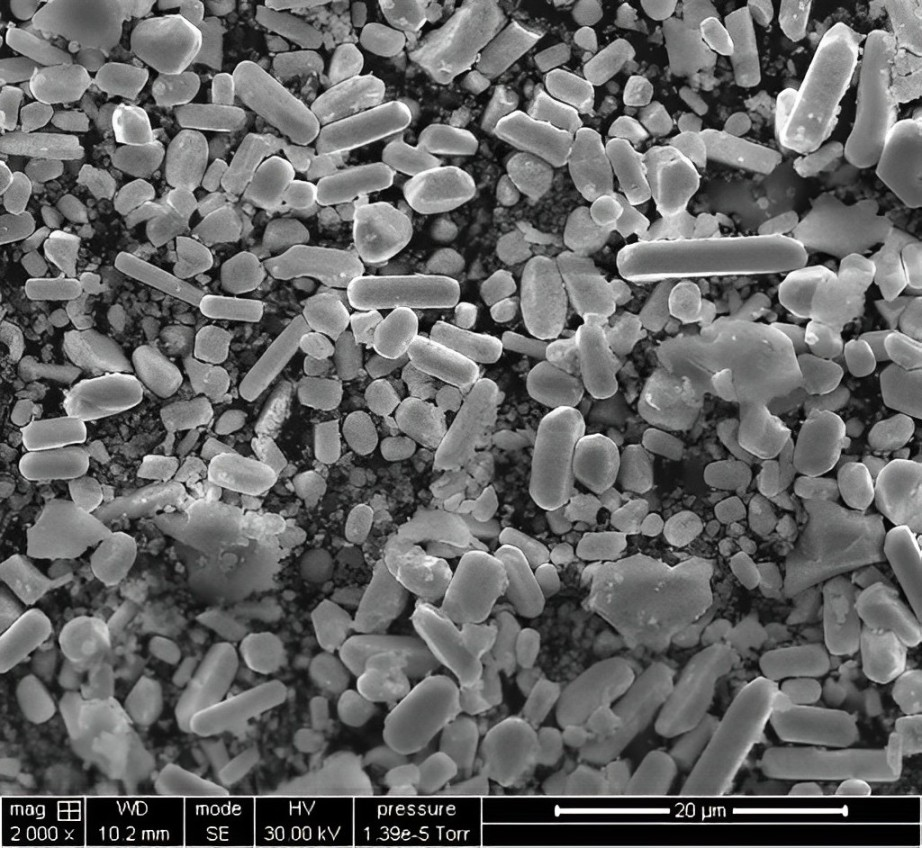
Most security phosphors in the industry are made by solid-state reaction: powders baked at high heat into a hard cake, then crushed and milled. What comes out is a mix of jagged chunks, a micron and larger, no two alike. Intelligent Material® is grown crystal by crystal in solution, to a recipe, so every crystal comes out small, the same size and the same shape. Drag the line to compare.
Partners under NDA
The crystal's response can be tuned in several independent ways. How we do it is shared with partners under NDA.
No code yet? Request NDA access from Viva Bell.
Partners under NDA
The same crystal platform can convert light in either direction. Details for partners under NDA.
No code yet? Request NDA access from Viva Bell.
Partners under NDA
How crystal shapes, emitters and a reader antenna combine into one lock. Shared with partners under NDA.
No code yet? Request NDA access from Viva Bell.
Partners under NDA
Layered crystals give each product family its own code. The architectures are shared with partners under NDA.
No code yet? Request NDA access from Viva Bell.
Partners under NDA
Layered crystals give each product family its own code. The architectures are shared with partners under NDA.
No code yet? Request NDA access from Viva Bell.
Partners under NDA
Crystal recipes, timing and layers multiply into a code space that keeps growing with every product line. The code space is shared with partners under NDA.
No code yet? Request NDA access from Viva Bell.
Where the code goes
The crystals are inert, uniform and smaller than a wavelength of light, so they disperse into the materials manufacturers already use, at parts per million to thousandths of a percent. The code is made into the product, not stuck on afterwards.
The most common home for the code. The crystals are smaller than the nozzles and pigments the ink already carries.
Compounded into masterbatch pellets, so every molded or extruded part carries the code from the first shot.
Added with a spinning ingredient at about 5 ppm in the finished fiber, and readable all the way to the finished garment.
Blended into the melt to prove origin, even after the metal comes back as scrap, or carried in coatings on the surface.
Coated crystals disperse in oils and fuels to mark the product, or are injected to trace where fluid flows underground.
In the adhesive that seals a package, so opening it leaves a measurable trace. Surgical packaging uses about 0.001%.
Anything that can hold a fine, inert powder is a candidate: paper, glass, ceramics, rubber, wax, paints, even cement. We test the crystal in your own material first.
Start with a sample →*Any food, cosmetic or medical use requires its own safety and regulatory review. Loadings shown are typical examples.
Partners under NDA
Start from the signal you need and we design the crystal around it. The design bench is open to partners under NDA.
No code yet? Request NDA access from Viva Bell.
Christopher B. Murray is an inventor on the IMS / University of Pennsylvania uniform-crystal patent family. He was also first author, with David Norris and Moungi Bawendi, on the landmark 1993 paper describing a controlled synthesis of nearly monodisperse semiconductor nanocrystals.
The 2023 Nobel Prize in Chemistry recognized Moungi Bawendi, Louis Brus and Aleksey Yekimov for the discovery and synthesis of quantum dots. The Nobel background specifically identifies Bawendi's 1993 advance in producing high-quality quantum dots with controlled size. IMS's work applies the same broader lesson to a different materials platform: precise control of nanoscale composition, size and architecture creates precise control of material behavior.
Synthesis and characterization of nearly monodisperse CdE semiconductor nanocrystallites.
Read the paper · 2023 Nobel Prize context
IMS / Penn patentMorphologically and size uniform monodisperse particles and their shape-directed self-assembly. Inventors include Howard Bell, Joshua Collins, Xingchen Ye and Christopher Bruce Murray.
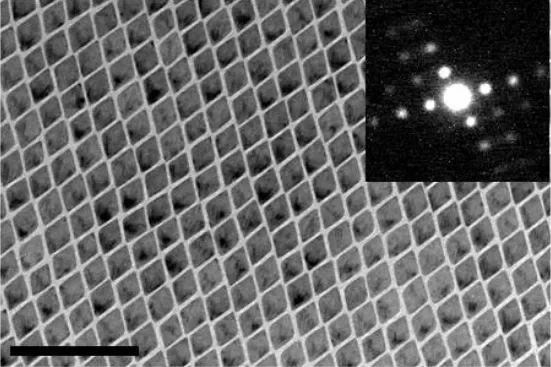
Intelligent Material grew out of work with Christopher Murray's group at the University of Pennsylvania. Two peer-reviewed papers, in PNAS and Nature Chemistry, both co-authored by Joshua E. Collins of Intelligent Material Solutions, show the core idea: grow every crystal to the same size and shape, and they arrange themselves into near-perfect patterns, with no one placing them.
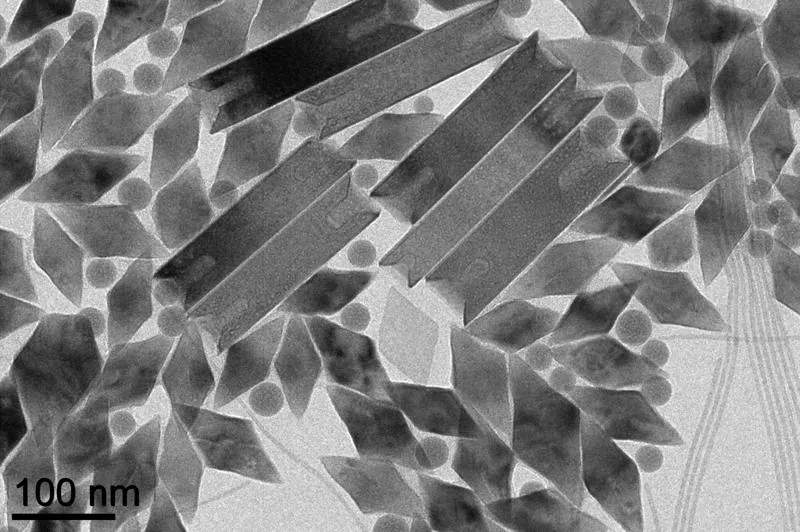
In a single flask, the team grew upconverting crystals of sodium yttrium fluoride, the same host used in many IMS crystals, doped with ytterbium and erbium for green light or ytterbium and thulium for blue. Changing just the reaction time and the ratio of sodium to rare earth turned spheres into rods, hexagonal prisms and flat plates.
Drawn by IMS from the paper's findings. Plates with only shape to go on pack one way; when unlike edges attract more strongly (gold), rows flip and alternate. That alternating pattern is what the electron microscope showed, and what the computer simulations predicted.
The 2013 paper moved to flat rare-earth fluoride plates, from lanthanum through holmium, shaped as rhombs and stretched hexagons. Pure geometry predicts one packing. The real plates often chose another.
The reason is the coating. Each crystal wears a fringe of oleic acid, and computer models showed it grips one kind of edge almost six times harder than another: about 0.70 versus 0.12 electron-volts. Edges that are "stickier" than others, or patchy, compete with shape to decide the pattern.
All illustrations drawn by IMS from the findings of Ye et al., PNAS 107, 22430–22435 (2010) and Ye et al., Nature Chemistry 5, 466–473 (2013). Read the papers for the original data and micrographs.
The portfolio spans uniform particles and assemblies, temporal authentication, rare-earth materials in articles and systems for identifying Intelligent Material from its engineered emission response.
Monodisperse particles and shape-directed self-assembly developed with the University of Pennsylvania.
Related claims involving up- and down-converting particles, polyhedral morphology and organized superlattices.
Authentication using engineered temporal characteristics of the emission response.
IR-blocking inks incorporating rare-earth Intelligent Material for article and transaction-card authentication.
Methods and systems for identifying Intelligent Material from changes in emission response under controlled illumination.
Start with the material itself. NovaVera and IMS define the excitation, emission, timing, power-density, magnetic and structural response your application needs, then supply it in the ink, plastic, fiber or coating you already use.
We use analytics cookies to see which pages help visitors. No advertising cookies. Cookie Policy