Counterfeiters refill genuine bottles, copy labels and re-seal caps. NovaVera protects the code, the bottle, the label and the seal, so every place has to agree before a bottle reads genuine.
4 placeson one bottle: code, glass or plastic, label, seal
Full speedprinted on the existing bottling conveyor
~1 ppmcrystal in label varnish
The challenge
Why the usual features fall short
Premium wine and spirits are attacked after they are sold: the bottle is drained, refilled and re-capped, labels are copied and wax seals replaced. A single feature on the label proves very little when the bottle itself is genuine.
Where NovaVera fits
Built into the material
A two-layer security ink prints a covert code on every bottle at full line speed, across the cap seam so a refill cannot line it back up. Crystals go into the bottle plastic, the wax seal and the label varnish. A reader checks that all of them agree.
Practical applications
Spirits
Protect the code, the bottle, the label and the seal.
Intelligent Material protects packaging for a major American spirits producer, in four places on the bottle. Counterfeiters refill genuine bottles, copy labels and re-seal caps, so the identity has to be in more than one place, and the places have to agree with each other.
On the producer's bottling line. The printed code glows under UV; the covert layer answers only the reader.
Use case 1 · Inkjet codes on the line
A covert code on every bottle, at full line speed.
We supplied a two-layer security ink and an in-line printer. The first layer is overt: a UV flashlight shows the code. The second layer is covert: an infrared crystal that only our reader can see or measure. It prints during normal production, bottle after bottle.
No new station. The printhead mounts on the existing conveyor and prints each bottle as it passes, so the line keeps its normal speed.
Same printer, same cartridge. The crystal is one more ingredient in a solvent ink for a standard thermal inkjet cartridge.
Small enough not to clog. The crystals in this ink are about 0.3 µm. Conventional security phosphors are a micron and larger, too big for inkjet heads, so they can't be printed this way.
Catches diversion. Each code is tied to where the bottle was meant to go. A scan in the wrong market shows where it leaked.
Catching a refill
Print the code across the seam. A refilled bottle can't line it back up.
Refilling is the most common spirits fraud: drain a genuine bottle, fill it with something cheaper and screw the cap back on. So the code is printed across the joint between the cap and the neck. Once the cap has turned, the two halves never meet again by accident.
Code across the seamLines up
Crystal in the cap codePresent
A careful forger might print a new cap that lines up. The ink can be copied; the crystal can't, so the reader still says no.
Untagged
Use case 2 · In the bottle
Crystals molded into the plastic.
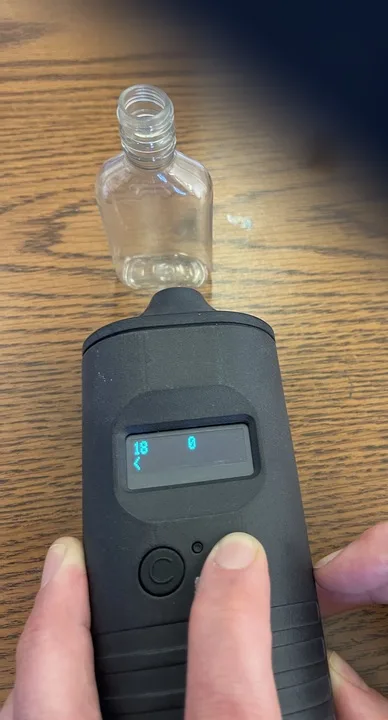
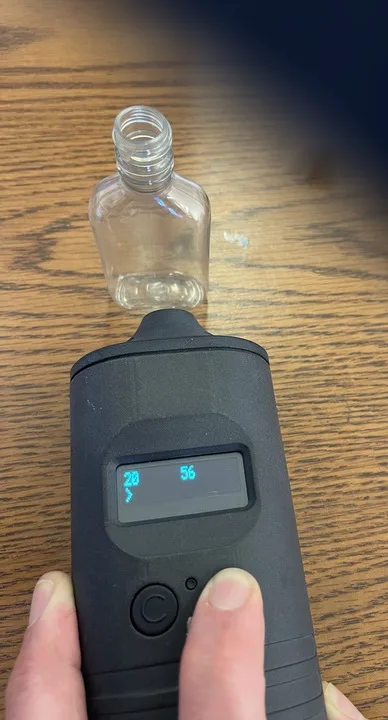
The bottle maker added crystals to 50 mL plastic bottles at about 1 part per million. The reader reads zero on an untagged bottle and a clear signal on a tagged one. The same tag can show recycled bottles coming back.
Use case 3 · In the wax seal
A seal that can't be quietly replaced.
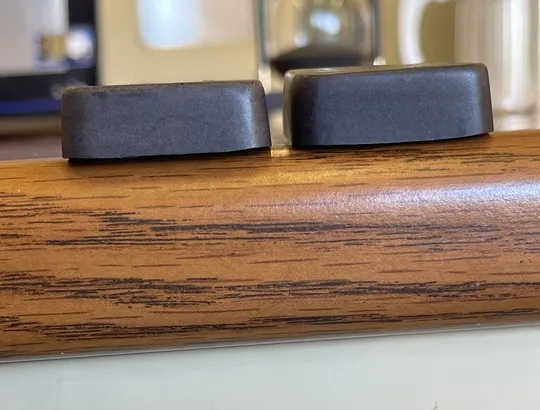
Hand-dipped wax seals were made with about 0.5% crystal. Tagged and untagged wax look identical, but the reader tells them apart, so a bottle that has been opened and re-dipped is caught. An imager can also map each seal's random crystal pattern as a one-of-a-kind print.
Use case 4 · In the label
Crystals in the label varnish.
The label printer mixed crystals into its varnish at about 1 part per million. Nothing about the label changes for the eye, but a copied label, however perfect, reads blank.
Partners under NDA
A serial number in the ink itself.
Crystal ink runs on standard thermal, continuous and UV inkjet lines, at full line speed, giving every item an invisible code. Equipment, recipes and line results are shared with partners under NDA.
Ready to evaluate NovaVera for Wine & Spirits? We work directly with technical evaluators and procurement teams, from the first sample to full production.